This is hilarious.
Wednesday, February 28, 2007


Tuesday, February 27, 2007
Gambling on Rudd
The Sydney Kings won three of four championships and the Wollongong Hawks didn't make the top eight this year. Consequently I don't really gamble any more. I can't afford it. If I had a clue about what I was doing then maybe I would.
Punter on the other hand has no real job and lives a lifestyle of debauchury only his gambling habbit can afford him to do so.
Punter on the other hand has no real job and lives a lifestyle of debauchury only his gambling habbit can afford him to do so.
Common sense has seemingly evaporated from political thought in this country and one cannot help but feel just a little sad. Then one realizes the magnificent opportunity for financial gain and most of the sadness dissipates like a Berocca hitting a glass of water on a seedy Sunday morning. For some reason, known only to the bookmakers themselves, the Australian Labor Party are favourites to win the next federal election.
Monday, February 26, 2007
The lights are on, but only Gittins is home
On Turnball's plan to phase out incandescent light bulbs:
Talk about high-handed intervention in a free market by the nanny state... Why the direct resort to command-and-control? ...why not apply the polluter-pays principle?I was with you Ross, right up until you said:
Yes, I am kidding. ...Once you understand how far we mere mortals depart from the assumption of rationality, it's easier to see the justification for government interventions intended to counter this whole new form of "market failure" and save us from ourselves.(I think this is also the first time I think I've heard Ross admit to being one of us mere mortals).
Tuesday, February 20, 2007
Salvation from carbon trading?
Alex Robson (who has a new weekly opinion spot in the Telly) has turned me right off carbon trading:
Thats not to say I'm necessarily now bullish on Pigouvian tax either:A carbon trading scheme will be similar to a tax on carbon emissions, except the size of the tax will be determined by the market and the government will receive no tax revenue.
Unless, of course, the states decide to charge stamp duty and the Commonwealth decides to levy capital gains tax on the sale of permits, just as they do on other assets. Then all levels of government will enjoy a massive revenue windfall.
Politicians have announced that Australia's greenhouse gas emissions must be reduced or eliminated completely... Never mind that this will not change global temperatures by even a fraction of a degree.
Thursday, February 08, 2007
Free coffee anyone?
Interesing business model for this US cafe (via freakonomics). Essentially you pay what you like. The idea is that the honour system will cause most people to pay and some will overpay (for a warm glow) subsidising those who underpay.
I think it will succeed; not much different from other business models which undercharge for some goods (in this case the coffee) and then overcharge on others (the warm glow effects). I think it would also have to rely heavily on repeat business. Would you rip off your barista if you are going to him everyday?
I think it will succeed; not much different from other business models which undercharge for some goods (in this case the coffee) and then overcharge on others (the warm glow effects). I think it would also have to rely heavily on repeat business. Would you rip off your barista if you are going to him everyday?
What is to be done?
The economic response to the growing scientific consensus on global warming seems naive and inconsidered. After reading a Robert Samuelson op-ed, I can think of many reasons why a global Pigouvian tax (or cap and trade system) is not going to happen:
- developing countries will not stand for it (and in any case economic growth is, rightly, much more important for them than global warming);
- governments are subject to a time inconsistency problem (there will be incentives to lower energy prices in the future) which investors can forecast and hence will be reluctant to invest in new technologies; and
- even if a global scheme is agreed upon I have not seen a convincing explanation of how you will measure how much carbon different firms are emitting.
In the face of this I think the simplistic arguments for cap-and-trade or a carbon tax are naive. Instead, governments have to rely on more direct and targeted interventions that do not rely on an unstable transmission mechanism. For example, governments could invest in clean-coal, nuclear or other carbon reducing technolgies (given the public good characteristics of innovation this could equally help 'correct' the behaviour of developing countries). For enforcement reasons, instead of putting an explicit tax on carbon it may have to tax products which use a lot of carbon (such as petrol, cetain metals, etc). I'm not really sure on the relative merits of such options but they seem much more attainable and realistic.
Cap-and-shade
The Australian's editorial continues to cloud the debate by propogating the unproven claim that an emissions trading scheme is far superior to a carbon tax:
Such a system [carbon trading] would be far less punitive than a per-tonne tax on coal or emissions which would ultimately be paid by consumers and which would chase industry and jobs overseas to less restrictive regulatory environments.
Who do they think is going to ultimately pay for the costs of buying permits? And again:
Likewise, the market signals sent by emissions trading will help create the research and investment climate necessary to develop carbon-reducing technologies such as gasification and geosequestration.
But so will a tax. People seem to believe that cap-and-trade is better becuase it's a market-based system. But this is just argument by labels not a rationale in itself.
The only reason I can think of for preferring a trading scheme is that perhaps the appartus that goes along with it (auction markets, traders, etc) will make it difficult for governments to change policy in the future and thus reduce soverign risk. I'm not sure that this is the case though since presumably a government would also be addicted to the tax revenue that a carbon tax would bring in.
Wednesday, February 07, 2007
Telecommuting
Tim Harford (aka the Undercover Economist) argues that the ubiquity of email, video-conferencing and other telecommunication media has increased the demand for travel (to conferences and meetings) and for living in big cities with networking opportunities. In essence:
... e-mail, internet networking and cheap phone calls have made it easy to maintain a lot of relationships. In principle some of them could be restricted to cyberspace, but how much fun is that? The same e-mail that allows you to maintain a long-distance business relationship also creates demand for more travel as people try to establish those relationships in the first place.
Although I think he raises a good point, surely at some point telco devices and face-to-face contact become substitutes. If more terrorist attacks cause large airfare hikes then surely people will rely more opn e-communication.
Also, having worked (rather unsuccesfully) in a telecommuting environment I can see the that face-to-face contact is very important in building relationships.
Perhaps then the effect that Tim is capturing is that Blackberry owners are more inclined to travel (and perhaps move house) for work purposes since they can more readily maintain their existing family/freind relationships through the use of email, cheap international calls, etc.
Howard's trippin
Howard seems lost on climate change. The other day he was saying that he does not support a tax on carbon but is happy to set a carbon price. But what's the difference? Now he is supporting a global emissions scheme but I don't see the big difference between a tax and cap-and-trade emissions target. Basic economics tells you that setting the price is equivalent to setting the quantity.
Much more important is how you are going to enforce either system, it would appear pretty easy for businesses to dodge the amount of carbon they emit; much easier than, say, minimising their profits for tax purposes. And even more worrying is how to discipline governments whose nations emit to much, perhaps lying about their emissions. What are we going to do to China? Invade them!
Turnball has the right message on the politics: sure it's a problem but there is nothing that Australia can do on its own. Even if we cut our production to nothing it still ain't going to materially change the warming to come. It's a global externality which requires a global response. Labor wants to play politics with a serious issue and is willing to put Australian wealth at jeopardy to score political points.
Tuesday, November 21, 2006
Friedman's influence
Milton Friedman had a great influence on my ideas. I started university as a communist ... but then I met some. And, while other authors, such as Orwell, turned me off hadcore economic planning but effectively I remained a social democrat until I read Friedman.
I read Free to Choose and it was a life-changing experience. Like most good ideas, the thing I took from it most was perhaps the simplest: that individuals, despite all their faults, know better what is in their interests than anyone else. As a general principle it's hard to argue against, I've always thought of it as the 'Christmas' principle. Imagine, if instead of us buying our own products, everyday was Christmas and we had to rely on our needs through, well-meaning, gifts from others. This is what central planning is like and it is a disaster. I've had some terrible Christmas presents over the years.
I've also spent tonight reading some of the obituries on Friedman. Two things have struck me. 1, Friedman's contributions cover such a wide range of topics; including creating financial derivatives, consumption theory and the relationship between free markets and democracy. 2, in his prediction of stagflation he is perhaps one of the only economists who designed a rigourous model that actually predicted economic outcomes. You often here about how Einstein's theory of relatively was demonstrated by the bending of light during an eclipse but it is rare that economics can create such controlled conditions.
Sunday, October 08, 2006
SIngapore Slung
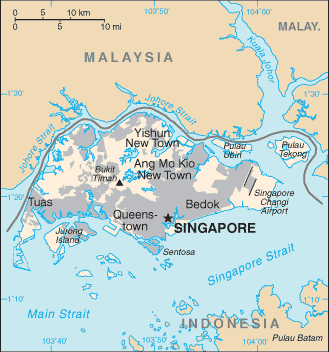
After the September IMF / World Bank meeting in Singapore, JP Morgan Economist Andy Xie wrote a ‘wrap up’ internal email, which (coincidently) was followed by his resignation from the venerable house of Morgan. Dr Xie had the temerity to suggest that ‘Singapore's success came mostly from being the money laundering center for corrupt
Indonesian businessmen and government officials.’ He followed it up for an explanation as to why Singapore’s GDP per capita has been stuck at USD25k per person for the past 10 years – ‘Indonesia has no money, So Singapore isn't doing well’
Newspapers have carried a few tidbits, but Mergeright has a copy of the three offending paragraphs.
_____________________
The dinner was turned into an Oprah with PM Lee Hsein Long at the center.The topic was on the future of globalization. People fawned him like a prince. Of course, he is. There are two reigning royalties in the world that the Davos crowd kiss up to, Jordan and Singapore. The Davos crowd are Repulican on economic issues and Democratic on social issues. Somehow, they manage to put aside their moral misgivings and kiss up to Lee Hsein Long and Abdullah.
I tried to find out why Singapore was chosen to host the conference. Nobody knew. Some said that probably no one else wanted it. Some guessed that Singapore did a good selling job. I thought that it was a strange choice because Singapore was so far from any action or the hot topic of China and India. Mumbai or Shanghai would be a lot more appropriate. ASEAN has been a failure. Its GDP in nominal dollar terms has not changed for ten years. Singapore's per capita income has not changed either at $25,000. China's GDP in dollar has tripled during the same period.
I thought that the questioners were competing with each other to praise Singapore as the success story of globalization. Actually, Singapore's success came mostly from being the money laundering center for corrupt Indonesian businessmen and government officials. Indonesia has no money. So Singapore isn't doing well. To sustain its economy, Singapore is building casinos to attract corruption money from China. These western people didn't know what they were talking about. Aside from the nauseating pleasantries, some useful information came out of it.
___________________________
The concentration of slander re: Singapore, suggests that Singapore applied pressure on JP Morgan to cut Dr Xie loose. You can’t blame Singapore for being annoyed – especially as there is probably a grain of truth; and you can’t really blame JP Morgan for protecting their own interests.
Still, it’s hard to see how a few Billion of dirty money each year could deliver their 4.5 million people an average of USD25k per year. Recall that GDP is VALUE ADDED. So 25k per person is about USD110bn of value added per year. Even if you take a massive cut of the dirty money, You’d have to washing a heck of a lot of it to skim that much.
According to the CIA world fact book, 2005 GDP was 110bn at market exchange rates, and 125bn at PPP. The working population is 2.3m, so average labour productivity is about USD55k per annum, after adjusting for relative prices (or 48k at market exchange rates).
The idea that money laundering could be driving all this growth is plain silly. However, there’s probably sufficient truth in the assertion to get up Singapore’s nose. Besides, if you can put pressure on folks who say annoying things, you do – don’t you?
Tuesday, August 15, 2006
Can the UN be any more useless?
Miloon Kothari, the UN Special Rapporteur on Housing (that is seriously his title) has spent the last fortnight in Australia evaluating the adequacy of housing. (I can't seem to find his report online but there are news reports here and here.)
Now he has some pretty bad things to say about outback Aboriginal housing. I don't know much about their conditions, but Miloon does not seem to recognise that it's a free country and they can move to the cities if the outback is such a raw deal. Instead, Miloon just wants us to give Aboriginal communities more handouts with no obligations: yeah that's really worked a treat for the last 30 years.
His other policy suggestions are similarly loopy. He thinks we should establish a "human rights-based national housing policy." What does that mean? He wants rent controls seriously considered. And I thought his grand title meant he was an expert on housing! Even Paul Krugman's against it, as he sums up, "Rent Control is a textbook case of Economic stupidity."
Kothari also wants the government to remove negative gearing and discounted capital gains. But these policies make it easier for people to buy and rent. Sure we could target them to low-income people but how is that going to engender a sustainable increase in affordability. Or should we be happy keeping people on welfare from cradle to grave?
More importantly, in the face of restrictive land release policies, such demand stimulants will simply raise the price of housing. A seemingly more useful report was released by the IPA recently playing up the importance of releasing land. I haven't had a chance to look at it in detail yet but at least it seems to have a basic handle on the concepts of supply and demand.
Now he has some pretty bad things to say about outback Aboriginal housing. I don't know much about their conditions, but Miloon does not seem to recognise that it's a free country and they can move to the cities if the outback is such a raw deal. Instead, Miloon just wants us to give Aboriginal communities more handouts with no obligations: yeah that's really worked a treat for the last 30 years.
His other policy suggestions are similarly loopy. He thinks we should establish a "human rights-based national housing policy." What does that mean? He wants rent controls seriously considered. And I thought his grand title meant he was an expert on housing! Even Paul Krugman's against it, as he sums up, "Rent Control is a textbook case of Economic stupidity."
Kothari also wants the government to remove negative gearing and discounted capital gains. But these policies make it easier for people to buy and rent. Sure we could target them to low-income people but how is that going to engender a sustainable increase in affordability. Or should we be happy keeping people on welfare from cradle to grave?
More importantly, in the face of restrictive land release policies, such demand stimulants will simply raise the price of housing. A seemingly more useful report was released by the IPA recently playing up the importance of releasing land. I haven't had a chance to look at it in detail yet but at least it seems to have a basic handle on the concepts of supply and demand.
How to do spend a lot to do absolutely nothing
The chicken-winged Treasurer announced today the Government's response to the Redtape Reduction Taskforce Report. And what an absolute joke. If one wants an example of government-ese and how to say a lot with saying nothing, then this is the response to read!
The Government has agreed to token reforms of existing laws, including working to harmonise conveyancing laws ... man, what great reforms!!!! This is in the same league as floating the AUD, or reducing tariffs.
A more important aspect of the redtape reforms is the plan to address the flow of bad regulation. This is where the government-ese is at its best. The government has proposed to:
Oh, but what about the fabled compliance cost calculator .... the glorified excel spreadsheet that the best minds of the Office of Small Business (I know it’s an oxymoron) miraculously thought up .... well, all it does is multiply hours taken to complete forms by the hourly wage rate .... and, wait for it, each of these elements have to be manually entered by the user. So, the Government, in its analytical best, has solved all regulatory problems by adopting an excel spreadsheet that is completely user dependent!!!! In fact, the only government-value-adding is to enter the =A1*A2 code!!!!!
The RIS has become irrelevant largely due to the incompetence of the Office of Regulation Review, and the absence of any consequences of failure to do a RIS. Hands up who knows that Treasury only did a RIS for around 60% of regulations? And what consequences are there? None!!!! So what is the response of Government? Let’s change the name of the ORR to the Office of Best Practice Regulation. Wow!!!! Who would have thought that the problem of non-compliance by government agencies could be solved by a name change. Can you imagine it? I mean poor public servants completely oblivious to the ORR, but the OBPR!! I can see them trembling over their morning teas.
Ah gosh, anyone who thinks the flow of crap regulation will be reduced is smoking the same stuff Costello was when he thought he'd be PM.
In all seriousness though, the Government cannot be serious that this is economic reform. It is a disgrace. And to think of the resources spent on the Redtape Reduction Taskforce, and in preparing the response. It amazes me how expensive hot air can be.
The Government has agreed to token reforms of existing laws, including working to harmonise conveyancing laws ... man, what great reforms!!!! This is in the same league as floating the AUD, or reducing tariffs.
A more important aspect of the redtape reforms is the plan to address the flow of bad regulation. This is where the government-ese is at its best. The government has proposed to:
- include a cost-benefit analysis for new regulation;
- renaming the irrelevant Office of Regulation Review to Office of Best Practice Regulation;
- use of the business-cost calculator; and
- adoption of six principles of good regulation.
Oh, but what about the fabled compliance cost calculator .... the glorified excel spreadsheet that the best minds of the Office of Small Business (I know it’s an oxymoron) miraculously thought up .... well, all it does is multiply hours taken to complete forms by the hourly wage rate .... and, wait for it, each of these elements have to be manually entered by the user. So, the Government, in its analytical best, has solved all regulatory problems by adopting an excel spreadsheet that is completely user dependent!!!! In fact, the only government-value-adding is to enter the =A1*A2 code!!!!!
The RIS has become irrelevant largely due to the incompetence of the Office of Regulation Review, and the absence of any consequences of failure to do a RIS. Hands up who knows that Treasury only did a RIS for around 60% of regulations? And what consequences are there? None!!!! So what is the response of Government? Let’s change the name of the ORR to the Office of Best Practice Regulation. Wow!!!! Who would have thought that the problem of non-compliance by government agencies could be solved by a name change. Can you imagine it? I mean poor public servants completely oblivious to the ORR, but the OBPR!! I can see them trembling over their morning teas.
Ah gosh, anyone who thinks the flow of crap regulation will be reduced is smoking the same stuff Costello was when he thought he'd be PM.
In all seriousness though, the Government cannot be serious that this is economic reform. It is a disgrace. And to think of the resources spent on the Redtape Reduction Taskforce, and in preparing the response. It amazes me how expensive hot air can be.
Monday, August 14, 2006
How to pay teachers
Judith Wheeldon argues that merit pay systems for teachers are flawed because:
I agree with her that simplistic pay schemes that relate test marks to pay are not going to work. As Wheeldon points out, they will simply encourage teachers to teach to the test, or as demonstrated in Freakanomics, teachers will blatantly alter exam results to ensure better pay.
Her alternative plan to give principals more power to hire and fire is only a partial solution. Fundamentally, it does not provide the good teachers with any bonuses or extra rewards (instead it only punishes excessively bad teaching). The key problem with current arrangements is that the good teachers are also likely to be able to get rapid promotion in the private sector. So why would they go to a school where, no matter how well you teach, you might be waiting five years for a pay rise? No wonder most of my teachers were lemons.
However, it does get to the root of the problem of centralisation. As Friedman points out for the US:
If there was a functioning market at the consumption level then this would put sufficient pressure for the design of efficient incentives in input markets. But if we try and tack a merit pay system on to the existing centralised, beaucratic structure then, given their track record, departments will probably stuff it up. As Friedman argues, in the absence of market pressure, power needs to be put closer to consumers in some other way. Although, allowing principals to fire has some merit, vouchers have more.
PS: In other Friedman related links, his Free to Choose documentary is now available in full on google video. And, as Gregory Mankiw, points out here's another video that Milton would probably warm to.
Evaluating a teacher's work has many facets. The easy one, because it can be expressed in figures that naturally rank themselves, is exam or skills tests results. Unfortunately, these easy-to-understand numbers do not meaningfully reflect the job description of a teacher.
I agree with her that simplistic pay schemes that relate test marks to pay are not going to work. As Wheeldon points out, they will simply encourage teachers to teach to the test, or as demonstrated in Freakanomics, teachers will blatantly alter exam results to ensure better pay.
Her alternative plan to give principals more power to hire and fire is only a partial solution. Fundamentally, it does not provide the good teachers with any bonuses or extra rewards (instead it only punishes excessively bad teaching). The key problem with current arrangements is that the good teachers are also likely to be able to get rapid promotion in the private sector. So why would they go to a school where, no matter how well you teach, you might be waiting five years for a pay rise? No wonder most of my teachers were lemons.
However, it does get to the root of the problem of centralisation. As Friedman points out for the US:
When I went to elementary school, a long, long time ago in the 1920s, there were about 150,000 school districts in the United States. Today there are fewer than 15,000, and the population is more than twice as large.
If there was a functioning market at the consumption level then this would put sufficient pressure for the design of efficient incentives in input markets. But if we try and tack a merit pay system on to the existing centralised, beaucratic structure then, given their track record, departments will probably stuff it up. As Friedman argues, in the absence of market pressure, power needs to be put closer to consumers in some other way. Although, allowing principals to fire has some merit, vouchers have more.
PS: In other Friedman related links, his Free to Choose documentary is now available in full on google video. And, as Gregory Mankiw, points out here's another video that Milton would probably warm to.
Tuesday, August 08, 2006
Tricks for old goats
The bomber has been bellowing like on old bull 'bout broadband – but as usual, he was making little sense, and demonstrating a poor grasp of the broader issues. The proposed fiber investment was simply a shot at circumventing the declaration of the copper network, and only made commercial sense to Telstra on these terms. There are alternative broadband investments, such as ADSL2+, that make better sense from a purely economic point of view – however they are based on the declared copper network, and are therefore subject to existing access arrangements.
Sure, if Beazley can convince the electorate that there is a broadband crisis, and that it is the Government’s fault, then it may make good politics. However, he runs the risk of looking like he’s fighting Sol’s corner, not the consumer’s corner, which is not really the natural home of the labour party.
It the Government / ACCC had given Telstra the commercial assurances that they desired, Telstra would’ve pulled up the existing copper node-loop, and replaced it with fiber. This would’ve meant that the ‘declared’ infrastructure – the stuff on which the Government set the prices Telstra could charge its competitors – would’ve been replaced with ‘undeclared’ infrastructure – on which the Government did not set the prices Telstra could charge its competitors. This would’ve allowed Telstra to regain control of the bulk of the wholesale prices it charges – effectively guaranteeing Telstra a new piece of monopoly infrastructure from which it may earn its fresh stream of excess rent.
This investment offered only marginal technical benefits above what is available from copper local loop, and ADSL2+ enabled exchanges, but it had a valuable strategic advantage. Telstra was willing to pay $4bn (the investment’s cost) to get control of the wholesale price they could charge, even though it would not give them a significantly better product for the retail market. The fiber product is only a little better (technically) than the ADSL2+ product, so Telstra would’ve struggled to charge much more for it then they might’ve for ADSL2+.
The fiber investment would’ve given Telstra the power to charge competitors whatever it liked – which would’ve almost certainly led to higher prices for broadband, regardless of the speeds on offer.
Thursday, July 13, 2006
Sunk already

Beazley ought to have a sinking feeling.
The May and June employment reports appear to have saved the Govt’s Workchoices bacon – certainly smirky pete was looking like the cat that got the cream when doing the post employment gloat on Thursday afternoon. In the previous two months, 99.7k jobs have been added: 72.5k full time jobs (+1%), and 27.2k part time jobs (+0.9%). The unemployment rate is 4.9%, on both trend and seasonally adjusted estimes, and vacancy data points to ongoing employment gains.
The Industrial relations laws had the potential to be the undoing of the government. Had the economy been headed into a downswing, freer ability to sack employees might’ve been a disaster. As it stands, I expect that the unemployment rate will be 4.5% before the 2007 election, and that real wages growth will be about 4%y/y. The Govt is not yet willing to attribute the gains to workchioces – for fear that the economy may turn, and that the downturn may be blamed on the policy, however we at merge-right need not be so coy.
Howard will beat Beazley in 2007. Unemployment will be at 30yr lows (prob below 4.5%), wages growth will be 4%y/y, and the Liberal campaign will be that unemployment is always higher under a labour govt – when the unions kick outsiders out of jobs, to the benefit of their members (who will be 15% of the private sector labour force by this time). By the 2010 election, it will be too late for a third round of roll-back.
Bye bye Beazley.
Tuesday, July 11, 2006
Milne miscalculates
One thing that the phoney war between Howard and Costello has proven was that Latham was right. From The Latham Diaries:
Costello's own confused words proves this. On Monday afternoon he said:
Update: Having just watched Milne on Lateline it is clear that the strategy is to set up a credible threat. That is, if Howard goes to the next election, Costello will challenge and bring them both down together, ruining Howard's legacy. Basically, Costello is saying that since I can't have the leadership on a platter I'll extort it out of you; anything but having to actually gain the support of my colleagues.
Is the threat credible, though? I still think Costello has greater payoffs from sticking around and waiting for Howard to leave. Howard may want to reevaluate how quickly he promotes Turnbull though.
The Dwarf [Glenn Milne] is just a frustrated politician; fancies himself as a player, not just a commentator: Circa 1997, he told me how he backed Keating over Hawke and planned to do the same thing for Costello over Howard. He should stick to his day job. (p. 189)Milne kicked off the whole story in an article in the Sunday Tele. However, if Milne is really trying to use Walletgate to get Costello into the Lodge then its been a spectacular disaster. What did he think was going to happen? Even if he could prove that Howard lied that hasn't stopped Honest John in the past. And since the whole story hinges on the interpretation of a private meeting that happened over ten years ago, who gives a stuff?
Costello's own confused words proves this. On Monday afternoon he said:
He told me that he intended to do one and a half terms as Prime Minister and then would hand over. I did not seek that undertaking ...That doesn't sound like an undertaking to me. Howard oulined what he planned to do and those plans have changed. So what? Costello should ask Milne to stick to his day job indeed.
Update: Having just watched Milne on Lateline it is clear that the strategy is to set up a credible threat. That is, if Howard goes to the next election, Costello will challenge and bring them both down together, ruining Howard's legacy. Basically, Costello is saying that since I can't have the leadership on a platter I'll extort it out of you; anything but having to actually gain the support of my colleagues.
Is the threat credible, though? I still think Costello has greater payoffs from sticking around and waiting for Howard to leave. Howard may want to reevaluate how quickly he promotes Turnbull though.
Tuesday, June 13, 2006
WWII redux
 What a great game last night! Especially entertaining was the historical parallels with the Second World War.
The Japs got out to an early lead with a surprise, illegal strike and then tried to hold their early gains against an ever-expanding attacking force. (With the odd kamikaze attack by a lone striker.)
I thought Australia's new passing based game (directed by coach 'Guss your Daddy') was very akin to Macurthur's island hopping strategy in the Pacific. I give credit to Graham Arnold, a Pacific theater buff, for exposing the Japs' historical weakness to long supply lines.
And, finally, just when you thought that the game was going to deteriote into an ugly, drawn stalemate, the Allies dropped a couple of bombs (see right) to finish the Japs off!
Thursday, May 18, 2006
Overworked and underpaid
 Jealousy is still alive and well in Australia. Only a week after the left were pointing out that cutting taxes actually means giving more tax back to those that already pay a lot, we now have the same hand-wringers whinging over the $21 million a year (or $1.8m/month, $400k/week, $60k/day, $2500/hr, $40/min or 67 cents per second) man, Alan Moss.
Poor old Mossy. This bloke works hard to get to the top. Starting at Mac Bank's predecssor in 1977. He worked his way up, playing a key role in the formation of the Bank. And, instead of lauding him as an example for all Aussie kids to aspire to, our journos just pour forth envy and complain that surely $21 mill is far too much.
But how do we know how much is too much? Far from being overpaid, could Mossy be getting less than he is worth?
The sin of jealousy is not confined to the Antipodes, over in the States there has been a similar controversy over the six fold increase in executive pay since the 1980s. Two economists have recently shown that there is a perfectly rational reason for this growth.
Their basic thesis is that a manager's value is a function of his talent multiplied by the size of the firm he is managing. Thus, a manger who adds 5 per cent value will be worth $45 more in a $1000 firm than managing a $100 firm. This is why the MD of your local fish and chip shop probably gets paid less than Sol Trujillo.
So applying this analysis to Al's pay packet it is clear that Mac Bank shareholders are getting him at a steal. Back when Big Mac first listed in 1996 it's market capitalisation was $1bn. Benefiting from Mossy's oversight, the firm's capitalisation has increased by a factor of 15, to $15bn. Unfairly, Alan's only recieved a just under 1000 per cent increase in his salary, from $2.3m back in 1996. The gap is so great that even the 8k/week ($1.1k/day, $48/hr, ...) donation from the Treasurer can't make up for this massive injustice.
Monday, May 15, 2006
Howard's steady hand

A very close friend has often said to me: ‘yeah, well Howard’s OK, but what’s he done? Nothing!’. To some extent it’s true, other than the GST, and staying in power, Howard has not taken the nation forward with the same sort of aggression as Keating. Then again, he’s not had the bipartisan support that Keating and Hawke enjoyed. In any case, the best answer I can muster is not to underestimate the value of a steady hand on the tiller.
Plenty of nations mess up. And the more prosperous the background factors, the more major the stuff-ups: so during a commodities boom, you get the biggest stuff ups of all. The risk from Labour, and the distinction between the Labour and Liberal was put to the fore in the liberal budget, and the Labour reply. Whereas the liberal party offered an uncapped subsidy of childcare places, the Labour party promised $200m for Govt owned childcare centers on school grounds, placed in locations of their choosing. The talk about not putting them in places where there were already sufficient places (in contrast to the liberal scheme, which might see ‘chaotic, and wasteful, competition’) was telling.
The contrast between the two parties is sharpest on this number. The liberal party, which simply promised to fund places, of whatever type, and in whatever location, that mums and dads prefer. Or the Labour party, which is going to build the centers it likes, in places it chooses: I bet a Labour Govt would deliver places to marginal electorates, give control to teacher’s unions, and use the threat of socialized competition to cajole political donations from Mac Bank (Childs Family Kindergartens) and ABC learning.
The pattern repeats itself with broadband, where the Labour party is making plans for a major Govt funded broadband investment: about $3bn, but you know how these publicly funded projects go over budget. While the Liberal Govt has a stupid one-time slush fund for the national party (from which Beazley is pinching $2bn), at least it is not using the proceeds of the Telstra sale to diversify back into the stinking telecommunications sector. Imagine Govt ownership: Telstra would still provide a shitty service, but it would employ triple the workforce, and be further overpriced service. Beazley has form on this, Keating won the fight to privatize Telstra over the top of Beazley’s protests in the 1990s.
Beazley made promises of an infrastructure taskforce – which is really a vehicle to spend government savings. From the previous budget, we know that the plan is to use the future fund to directly invest in infrastructure: yes, that means more Govt owned assets. Just when you thought we’d finally got rid of all that inefficiency, the Labour party is promising to invest the future fund in Govt controlled infrastructure. Given the choice, I’d sooner invest in Mac Bank or Babcock and Brown (in fact, I have) – and I think that the future fund should be given that choice. Instead, Beazley wants to spend the money on jobs for the CFMEU and associated unions.
And the Beazley formula for the skills crisis – banning foreign workers. We will, instead solve the current problem by training ‘our own’. Only problem with this is that 1. training takes time, and 2. the bulk of those not currently in training are beaten by the foreigners as the foreigners are considered to be a superior employees. Training the less able domestic dross will take more time, and banning the foreign supply will put more pressure on capacity.
The difference between the Beazley and Howard budgets testifies to the value of value of having a steady hand on the economic tiller. There may not be much really big reform left to do, but there is always the chance that a govt awash with cash will make some really big mistakes – like reinvesting in telecommunications, or socializing childcare. The difference between 10 liberal and 10 labour budgets is a vital, efficient, and productive economy – with only minor stuff ups.
Ok, to finish with, the confessions: I'm a card carrying member of the liberal party; I'm an economist; and I don't like Beazley. The first, I figure, disposes me to a certain amount of parochialism, and you’ll just have to live with that. The second, I hope, is the clear foundation for my argument. The third, well, that’s the place from which I draw the vitriol. Let’s face it, there’s not much to like about the big bellowing cow – he’s got only two settings, boring gas-bag, or wanna-be Churchill.
Subscribe to:
Posts (Atom)